About the GP Patient Survey
The GPPS has Official Statistics status. It provides insight into patient experience of primary care, including local GP practice services, the last contact with the practice, the quality of care at the last appointment, overall experience of the GP practice, experience when the GP practice is closed, pharmacy services and NHS dentistry, as well as current health circumstances and demographics.
The survey provides invaluable insight, supporting improvement and accountability, and also gives patients information to help them make choices about which GP service they use. Delivery is overseen by a Steering Group, who reflect the wide range of stakeholders of the survey.
Both the survey design and questionnaire have evolved over time, in response to a range of factors, including changes in policy and developments in survey good practice. We describe this evolution and the latest changes in more detail below.
Transitioning to an ‘online-first’ methodology
GPPS began as a largely paper-based survey but has more recently transitioned to ‘online first’.
Each change to the survey design throughout the years has been robustly tested using randomised control trials on a sub-sample to provide a clear understanding of the impact on response rates, question response, data quality, non-response bias, and costs. The chart below demonstrates how changes in the survey design since 2017 have increased the proportion taking part online significantly. From 2021 this was accelerated by a change in the sample frame, which provided access to mobile phone numbers allowing us to send SMS reminders with unique links to the online survey.
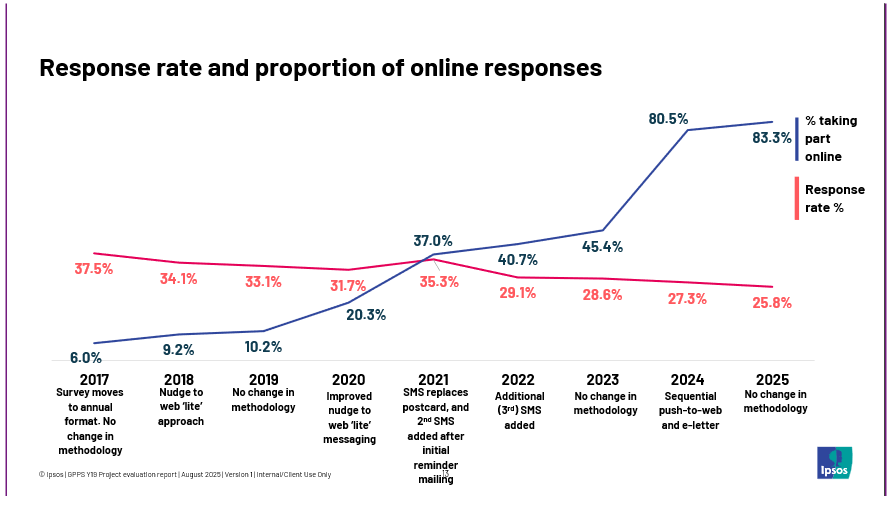
The most recent significant change was tested in 2022 and 2023, and rolled out to the main survey in 2024. Patients are now sent an initial letter by post, followed by up to five SMS reminders containing unique survey links, some of which include a link to an e-letter. A paper questionnaire is only provided in the final reminder mailing. This strategic shift aims to ensure the survey remains cost effective, without impacting data quality or representativeness. It works by:
- Prioritising online participation: The initial mailing and use of text messages strongly encourages patients to take part online, reflecting the increasing preference for digital engagement.
- Targeted use of paper: Paper questionnaires are reserved for the final mailing, ensuring the survey remains inclusive of people who cannot take part online or prefer offline options.
- Introducing e-letters: We have replaced one of the paper mailings with an e-letter for those with mobile numbers (those without mobile numbers continue to receive a paper reminder). This provides a timely and cost-effective reminder for anyone who hasn't responded online, with a direct link to the survey reducing the need for people to enter their log-in details.
For more details about the change in the survey methodology, see the GPPS 2024 Technical Annex and the Changes to the GP Patient Survey. For more details on previous experiments, see the GPPS 2023 Technical Annex. All reports are available on the GP Patient Survey website: www.gp-patient.co.uk/surveysandreports.
Redesigning the questionnaire for a new era in primary care
Like the survey design, the questionnaire has been redeveloped at various points in the survey’s history, responding to changes in the way primary care services are delivered and how patients experience them.
GPPS began as a two-page questionnaire. It quickly expanded to four pages, and then to the current eight-page format. Now that the majority of people take part online, the survey also includes a small number of online only questions, including questions on vaping behaviours and the NHS Accessible Information Standard. These online only questions were published for the first time in 2025 as official statistics in development.
Each year the questionnaire is reviewed following feedback from stakeholders, and proposed changes are always cognitively tested with patients to ensure the questions and answers are widely understood. Often the changes are only minor, but there have been some points where more significant review has been required, including a major redevelopment of the 2024 survey. Previous survey results showed that services need to change to improve patient access and better align with patient priorities. The publication of the Fuller Stocktake and the Delivery Plan for Recovering Access to Primary Care set out key changes in response, including implementing modern general practice access alongside other key initiatives for making it easier for patients to get the help they need and expanding the role of pharmacy services. To ensure that GPPS remained relevant in this context, it was essential to review and update the questionnaire. Due to the extent of the changes the 2024 results provided a new baseline for measuring patient experience of primary care.
There is more information about the questionnaire redesign process, on the GP Patient Survey website.
An ongoing resource for further research
As part of the questionnaire redevelopment and exploration of how to broaden the utility of the GPPS results, in 2025 the survey included a question seeking consent for recontact. This has provided a pool of patients, with known experiences and demographics, who can be contacted for further related research. Use cases for the recontact database are currently being explored among unpaid carers, on experience of NHS dentistry services, and use of the NHS App.
Latest results
In the 2025 survey, overall experience of each service had improved significantly since 2024:
- 75.4% patients reported a good overall experience of their GP practice (up 1.5 percentage points from 2024).
- 69.6% had a good overall experience contacting their GP practice the last time they tried (up +2.3 percentage points).
- 57.0% said their experience of NHS services when their GP practice was closed as good (up +1.1 percentage points).
- 88.0% had a good experience of pharmacy services (up +1.2 percentage points).
- 70.8% reported a good experience of NHS dental services (up +1.6 percentage points).
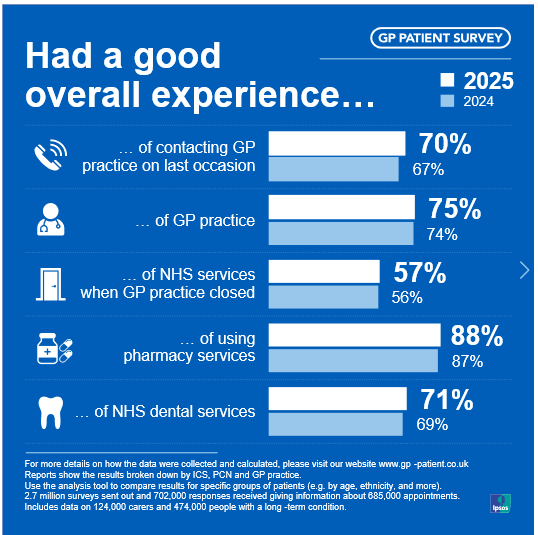
While these results show positive signs for recovery in primary care, they hide a lot of variation, between practices and different population groups. GPPS also provides detailed demographic breakdowns for all questions, which shows that health inequalities persist, with particular groups consistently less likely to have a good experience.
Some facts about your data set
In 2025 the survey received 702,837 responses from patients aged 16 years or over who are registered with a GP practice in England. This includes 585,338 questionnaires completed online (83%). The survey has a national response rate of 25.8%.
Fieldwork for the survey is undertaken between January to March each year. The 2025 survey took place between 30 December 2024 to 1 April 2025.
Where to find survey materials and reports:
- All results are available on the GP Patient Survey website: https://www.gp-patient.co.uk/surveysandreports
- Analyse the latest results by organisation or demographic, and run crosstabulations of the data using the GPPS Analysis tool: https://www.gp-patient.co.uk/analysistool
- Access aggregate reports and datasets: https://www.gp-patient.co.uk/surveysandreports
- Access individual level datasets: applications can be submitted for permission to access the individual level data, subject to approval by NHS England. Please email: [email protected]
Author Bios:
Rachel has over 25 years of experience in social research, designing, directing and delivering research projects. She specialises in delivering large quantitative surveys with complex elements. Rachel currently leads on the GP Patient Survey for Ipsos, providing overall direction for the study.
Eileen is an Associate Director at Ipsos and Co-Head of the Ipsos Survey Research Methods Centre, specialising in all elements of large-scale random probability surveys, including delivering surveys used as Official Statistics. She supports teams across the business in survey methodology and design, with a particular focus on health and social care research.
Nina is an Insight Support Manager in NHS England’s Insight and Voice Team.
Nina has worked on various patient experience insight projects, currently leading on the GP Patient Survey and the Friends and Family Test.